
The Misinformation Effect: Remembering What Never Happened
Imagine watching a short film of two cars colliding. Nothing about the crash looks dramatic, and there is no broken glass anywhere. A week later, you answer a few questions about it, and you can clearly picture glass scattered across the road. You are not making it up. You genuinely remember it.
That false detail came from a single word in a question you answered days earlier. Psychologists call this the misinformation effect, and it is one of the most important findings in the psychology of memory, with serious consequences for eyewitness testimony and the law.
Key Takeaways
- One verb in a single question made some people “remember” broken glass that never existed. The wording of a question matters far more than most students expect.
- Researchers have planted entire childhood memories, and a large 2023 replication found the effect was even stronger than the original study reported.
- Mistaken eyewitnesses show up in most DNA exoneration cases in the United States, which is why the way witnesses are questioned matters so much.
- Some people are more vulnerable than others, and age is only part of the story.
- Warnings can protect memory, but timing is everything. A warning given at the wrong moment barely helps.
What Is the Misinformation Effect?
The misinformation effect is the change in memory, usually for the worse, that happens after someone is exposed to misleading information about an event (Loftus, 2005). The key word is after. The misleading detail does not distort what you perceive in the moment. It sneaks in later and gets woven into the memory you already have.
A solid misinformation effect definition for exams includes three parts: an original event, misleading information that arrives afterward, and a later memory report that includes the misleading detail. Researchers build their studies around exactly this three-stage setup (Loftus, 2005).
Because it distorts memories of specific experiences, the misinformation effect is mainly a problem for episodic memory rather than semantic memory, the store of general facts you know.
It Is Not the Same as Lying
People affected by misinformation are not lying. They sincerely believe the altered version. Once a false detail has been embraced, people can describe it with real confidence and vivid detail (Loftus, 2005). That is exactly what makes the effect so hard to spot from the outside.
Memory Is a Reconstruction, Not a Recording
To see why misinformation works, you need one basic idea: memory does not play back a stored video. Each time you recall an event, you rebuild it from pieces. Some pieces come from the original experience. Others come from what you heard, read, or assumed afterward.
Most of the time, this flexible system is useful. Loftus (2005) points out that the same updating process that lets misinformation in also lets people fix mistaken memories when they learn the truth. The catch is that the system cannot always tell a correction from an error.
This is also why feeling sure about a memory does not guarantee it is accurate. Strong metacognition, the ability to monitor your own thinking, helps you question your memories, but even careful thinkers cannot always sense the difference between a real detail and a borrowed one.
The Loftus and Palmer Car Crash Experiment
The study that put the misinformation effect on the map was published by Elizabeth Loftus and John Palmer in 1974. Half a century later, it is still a staple of intro psychology courses and a go-to example in discussions of leading questions.
Experiment 1: One Verb, Different Speeds
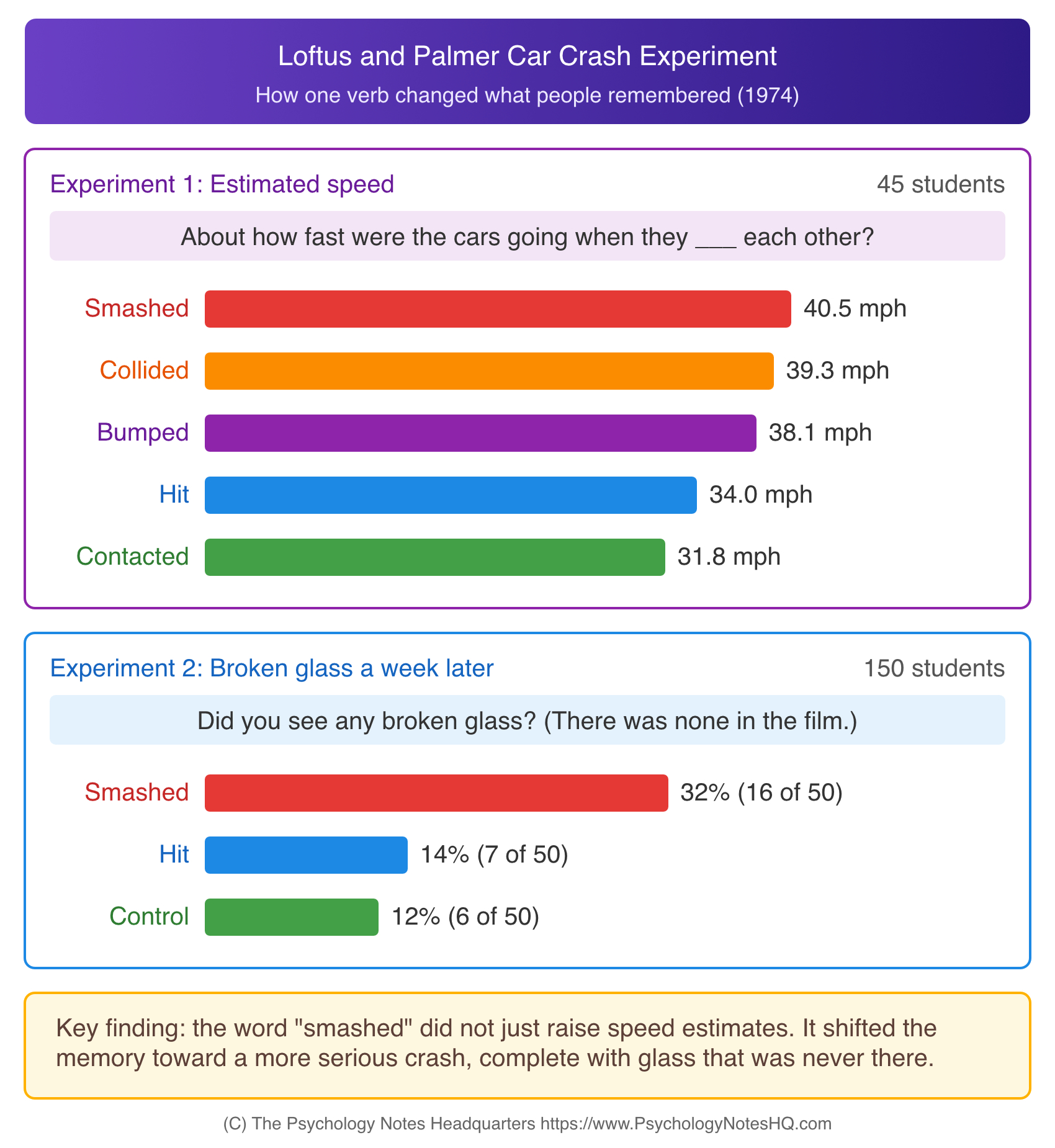
Forty-five students watched seven short film clips of traffic accidents. Afterward, they answered a set of questions that included one critical item: “About how fast were the cars going when they ___ each other?” Depending on the group, the blank was filled with smashed, collided, bumped, hit, or contacted (Loftus & Palmer, 1974).
The verb mattered. Students who heard “smashed” gave the highest average estimate, about 40.5 mph. Those who heard “contacted” gave the lowest, about 31.8 mph. Same films, same crashes, different words.
Experiment 2: The Broken Glass That Wasn’t There
Loftus and Palmer then tested whether the verb had changed the memory itself. In the second experiment, 150 students watched a film of a multiple car accident. One group got the “smashed” question, one got the “hit” question, and a control group was not asked about speed at all.
One week later, everyone was asked, “Did you see any broken glass?” There was none in the film. Yet 16 of the 50 students in the “smashed” group said yes, compared with 7 in the “hit” group and 6 in the control group (Loftus & Palmer, 1974).
Response Bias or Real Memory Change?
The first experiment alone could be explained by response bias. Maybe students simply adjusted their answers to fit what the question seemed to expect. The broken glass result is harder to explain that way. The verb “smashed” seemed to shift the whole memory toward a more serious crash, and serious crashes tend to come with broken glass.
Still, keep the limits in mind. Participants watched short clips in a lab with nothing at stake, and in every group most students correctly said they saw no broken glass.
The Lost in the Mall Study: Planting an Entire Memory
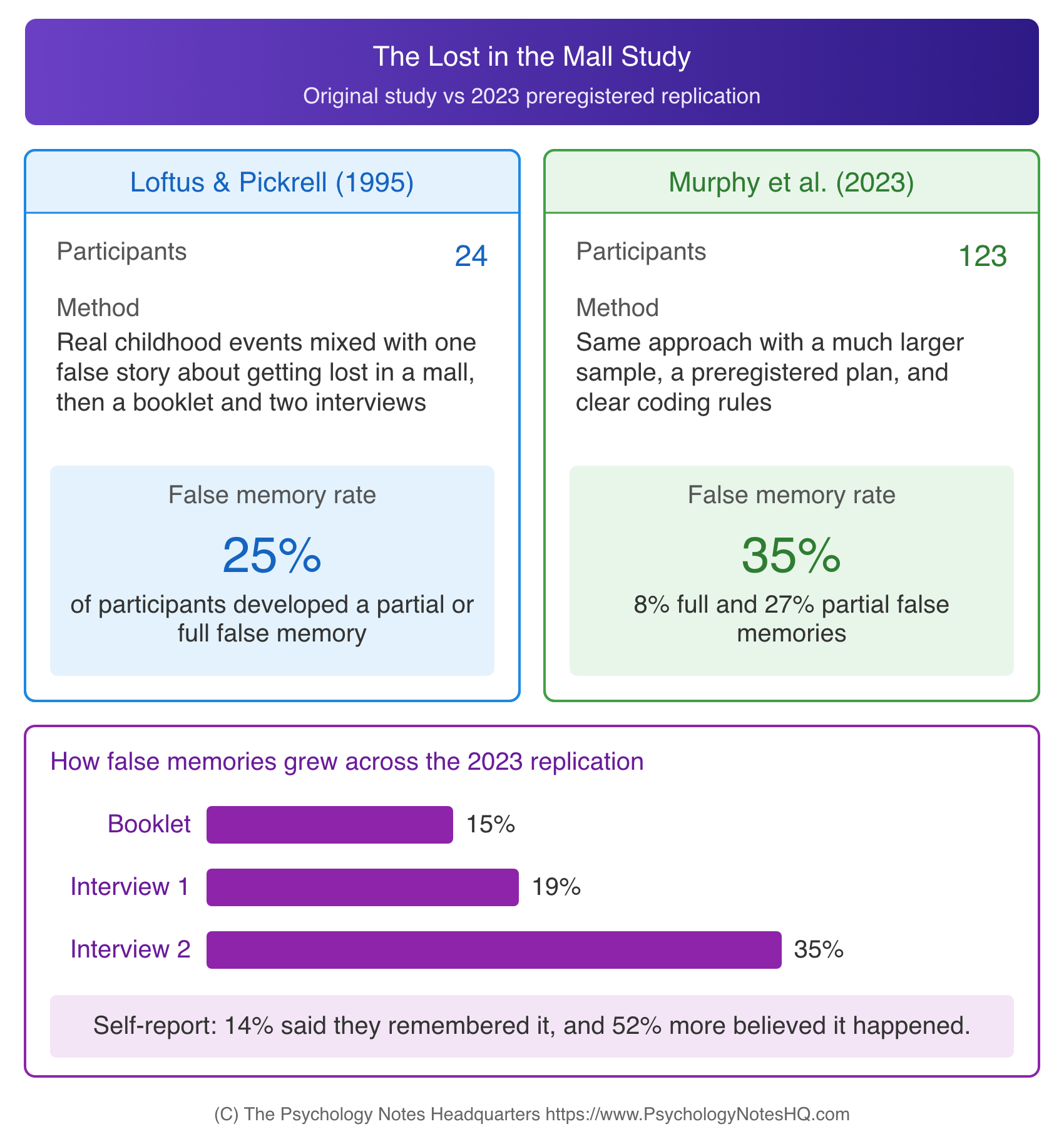
Changing one detail is impressive. Creating a whole event is something else. In the Lost in the Mall study, Loftus and Pickrell (1995) worked with participants’ relatives to write short descriptions of childhood events. The real events were mixed with one false story about getting lost in a shopping mall as a young child.
Across a written booklet and two follow-up interviews, participants tried to remember each event. About 25% came to remember the false mall event, either partially or fully (Loftus & Pickrell, 1995). Later studies using the same technique found an average false memory rate of roughly 30% (Loftus, 2005).
The 2023 Replication
The original study had only 24 participants, so a team led by Gillian Murphy ran a larger, preregistered replication with 123 participants. They coded 35% of participants as having a false memory of getting lost in a mall: 8% full memories and 27% partial memories (Murphy et al., 2023).
Two details make the replication especially useful for students. False memory rates climbed with each stage, from 15% in the booklet to 35% by the final interview. And when participants rated their own experience, only 14% said they remembered the event, while another 52% said they believed it had happened (Murphy et al., 2023).
At a time when the replication crisis has toppled plenty of famous findings, this one held up.
Eyewitness Testimony and the Reliability of Eyewitness Accounts
The courtroom is where the misinformation effect carries its highest stakes. Juries often find a confident eyewitness very convincing. Yet witnesses are exposed to misinformation in several ways: they talk with each other, they are questioned with leading or suggestive techniques, and they see media coverage of the event (Loftus, 2005).
The real-world numbers are sobering. According to the Innocence Project (n.d.), eyewitness misidentification played a role in about 69% of the 375 wrongful convictions overturned by DNA evidence in the United States between 1989 and 2020.
To be fair to the data, misidentification has several causes, and misinformation is only one of them. But it is one that investigators can control, which is why the reliability of eyewitness accounts depends so heavily on how witnesses are interviewed.
Why Consistency Is Not the Same as Accuracy
A witness can tell the same story every time and still be wrong. Research methods students will recognize the logic from reliability vs validity: a measure can be perfectly consistent and still miss the truth. That is why memory researchers treat eyewitness evidence reliability as something to investigate, not something to assume.
Misinformation Effect Examples in Everyday Life
You do not need a courtroom to see this effect at work. The misinformation effect examples below come from published research, and each shows a different route that misleading details can take into memory.
Talking With Other Witnesses
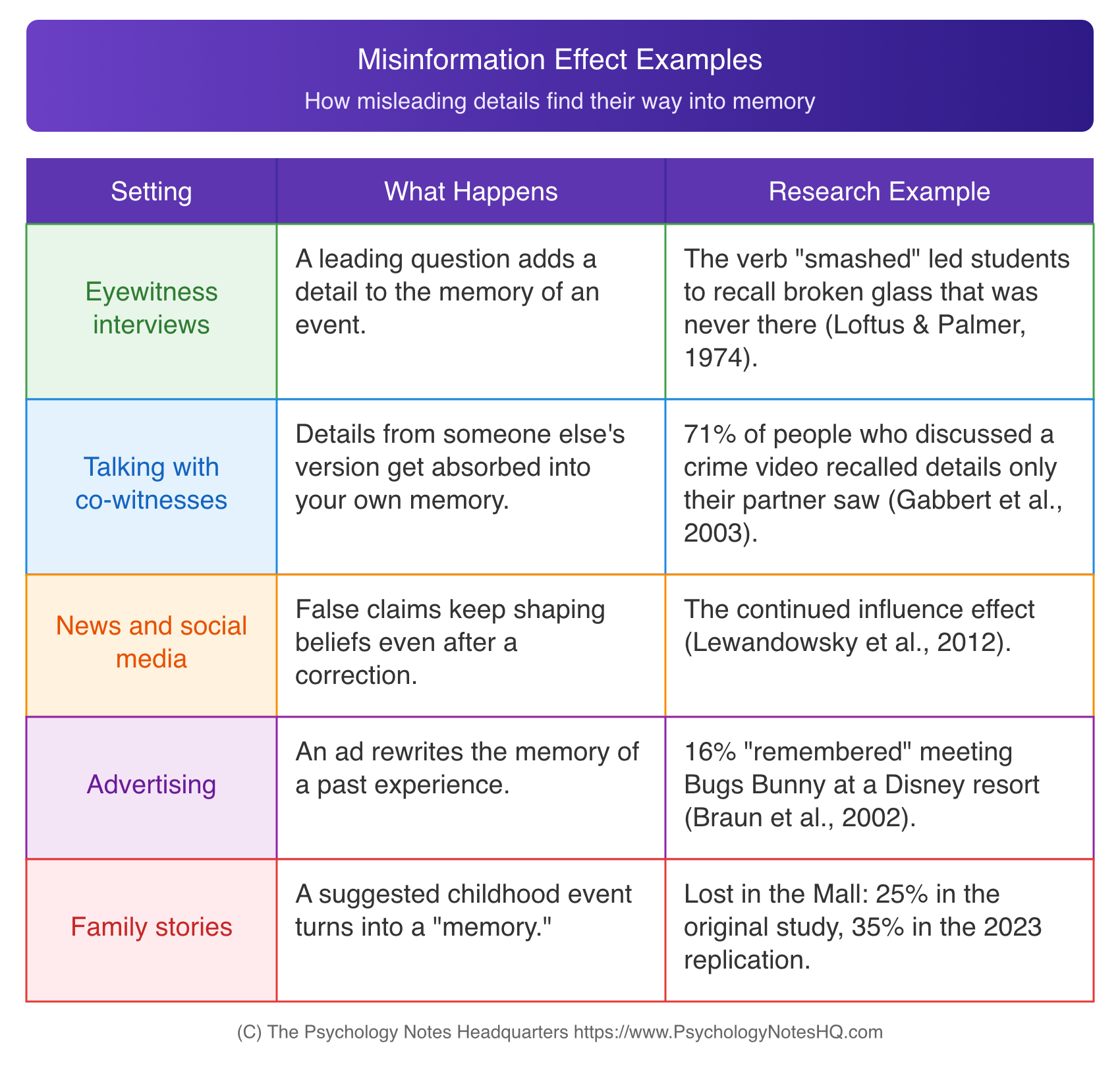
When two people witness the same event and then discuss it, their memories can blend together. In one study, pairs of participants watched slightly different videos of the same crime and then talked about it. Afterward, 71% of those who discussed the event went on to recall details they had only picked up from their partner (Gabbert et al., 2003).
Think of this as a memory version of conformity. We do not just go along with other people publicly. Sometimes their version quietly becomes what we privately remember.
News and Social Media
Early reports of breaking news can be incomplete or simply wrong. Even after people see and accept a correction, the original false claim can keep shaping how they think about the event. Researchers call this the continued influence effect (Lewandowsky et al., 2012).
Strictly speaking, this is a close cousin of the misinformation effect, since it concerns beliefs as well as memories. Lewandowsky et al. (2012) also note that misinformation is harder to correct when it fits a person’s worldview, which is where confirmation bias joins the picture.
Advertising
Ads can rewrite memories of past experiences, too. In one study, people evaluated a fake ad for a Disney resort that featured Bugs Bunny. About 16% later claimed they had met Bugs at a Disney resort, which is impossible because he is a Warner Bros. character (Braun et al., 2002, as cited in Loftus, 2005).
Leading Questions at Home, School, and Work
Leading questions are not only a police problem. A parent asking “Did he push you first?” or a manager asking “How rude was that client?” builds an assumption right into the question. The car crash research suggests those assumptions can shape the answer, and possibly the memory that follows.
Why Memory Is So Vulnerable to Misinformation
Source Misattribution
Often people remember the misleading detail itself just fine. What they lose is where it came from. Zaragoza and Lane (1994, as cited in Loftus, 2005) described this as the source misattribution effect: people come to believe they saw something that was only suggested to them. They also stressed that these errors are common but not inevitable.
Time and Discrepancy Detection
Misinformation works best after the original memory has had time to fade. A weaker memory makes it less likely that you notice the new information clashes with what you saw. This idea is known as the discrepancy detection principle (Loftus, 2005). If you miss the mismatch, the new detail slides in unchallenged.
Limited Attention
Misinformation effects are stronger when attention is stretched thin. Temporary states matter as well. In studies reviewed by Loftus (2005), people who believed they had drunk alcohol, and people under hypnosis, were more susceptible to misleading information.
Who Is Most Susceptible?
Everyone is vulnerable to some degree, but age makes a difference. Young children are more susceptible than older children and adults, and older adults are more susceptible than younger adults (Loftus, 2005). Limited cognitive resources may explain part of both patterns.
Personality plays a smaller but real role. Traits linked to greater susceptibility include empathy, absorption, and self-monitoring. People who report frequent lapses in memory and attention also tend to be more affected (Loftus, 2005).
The effect is not even uniquely human. Misinformation effects have been found in three-month-old infants, gorillas, pigeons, and rats (Loftus, 2005). That makes it hard to dismiss the effect as participants simply trying to please the experimenter.
Can You Reduce the Misinformation Effect?
There is no complete fix, but some strategies help, and timing is the big one. Warning people before they encounter misleading information helps them resist it. Warnings given afterward work only in limited situations, and they fail when the misinformation is highly accessible, for example after repeated exposure (Loftus, 2005).
The Cognitive Interview
In police settings, the cognitive interview was developed to draw out more from witnesses without leading them. Interviewers rely on open-ended prompts, let the witness do most of the talking, and help them mentally return to the scene. A meta-analysis found it produces a large increase in correct details with only a small increase in errors (Memon et al., 2010).
Everyday Habits
For the rest of us, two habits go a long way. Given the co-witness research above, it makes sense to write down or mentally rehearse what you remember before discussing an event with others. And when a detail feels vivid, pause and ask where it came from. Did you see it, or did someone tell you?
Final Thoughts
The misinformation effect is a reminder that memory is built for flexibility, not perfect accuracy. One verb can add broken glass to a car crash, a family story can create a childhood event, and a casual conversation can hand you someone else’s details.
Beyond the textbook definition of misinformation effect, the lesson for psychology students is practical: how a question is asked can shape the answer, and sometimes the memory itself.
References
- Gabbert, F., Memon, A., & Allan, K. (2003). Memory conformity: Can eyewitnesses influence each other’s memories for an event? Applied Cognitive Psychology, 17(5), 533–543.
- Innocence Project. (n.d.). DNA exonerations in the United States (1989–2020). Innocence Project.
- Lewandowsky, S., Ecker, U. K. H., Seifert, C. M., Schwarz, N., & Cook, J. (2012). Misinformation and its correction: Continued influence and successful debiasing. Psychological Science in the Public Interest, 13(3), 106–131.
- Loftus, E. F. (2005). Planting misinformation in the human mind: A 30-year investigation of the malleability of memory. Learning & Memory, 12(4), 361–366.
- Loftus, E. F., & Palmer, J. C. (1974). Reconstruction of automobile destruction: An example of the interaction between language and memory. Journal of Verbal Learning and Verbal Behavior, 13(5), 585–589.
- Loftus, E. F., & Pickrell, J. E. (1995). The formation of false memories. Psychiatric Annals, 25(12), 720–725.
- Memon, A., Meissner, C. A., & Fraser, J. (2010). The cognitive interview: A meta-analytic review and study space analysis of the past 25 years. Psychology, Public Policy, and Law, 16(4), 340–372.
- Murphy, G., Dawson, C. A., Huston, C., Ballantyne, L., Barrett, E., Cowman, C. S., Fitzsimons, C., Maher, J., Ryan, K. M., & Greene, C. M. (2023). Lost in the mall again: A preregistered replication and extension of Loftus & Pickrell (1995). Memory, 31(6), 818–830.
How to cite this article:
The Psychology Notes Headquarters. (2026). The Misinformation Effect: Remembering What Never Happened. Retrieved from https://www.psychologynoteshq.com/misinformation-effect/